Building a website in WordPress can be challenging under the best of conditions but, if you’ve ever sat in front of blank page with no idea where to start, wireframing might be for you. Wireframing is the process of creating a visual representation of how you want your webpage to look. Wireframes can range from low-fidelity (like a sketch in notebook) to high fidelity (like a full-color, digitally created mock-up).
A wireframe acts like a blueprint for building your webpage. It shows you where there should be textbooks, where there should be images or videos, what elements should be included in the header, and more.
Most importantly, wireframing doesn’t have to be overly complicated or daunting, anyone can do it with just a few easy steps.
Step 1: Determine the goal of the website (or page) you’re creating.
This will help you figure out what elements need to be included. For example, when I was wireframing the homepage for my personal portfolio website, one of the goals was to make my brand feel trustworthy to visitors. To accomplish this, I knew I wanted to leverage social proof so a testimonials section was essential.
Step 2: Get a piece of paper and sketch out the basic layout.
Technically you could do this digitally but, I find that the creative portion of my brain works better offline. It may also help to draw your elements onto individual sticky notes so you can test out different arrangements with ease.
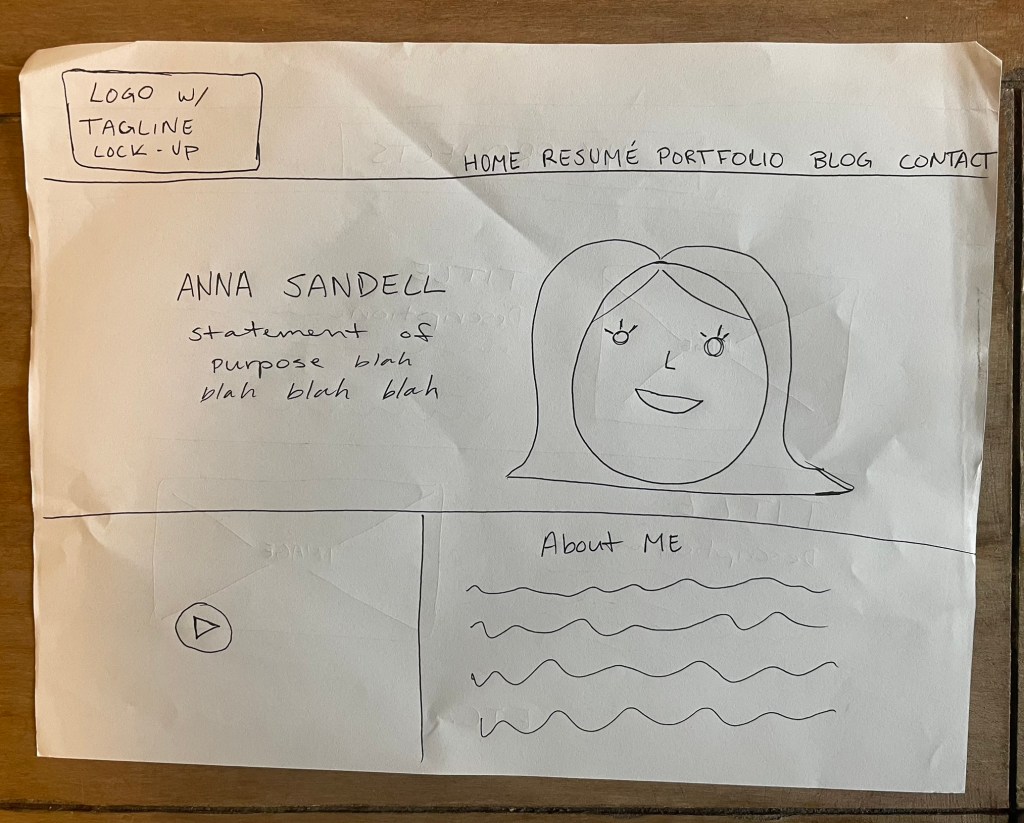
Something like this:
Step 3: Refine your first draft.
Do this by removing unnecessary elements and adding in any additional elements as needed.
Step 4: Choose a wireframing tool and create a high(er) fidelity wireframe.
There are plenty of options to choose from. WireFrame.cc is a great free option for more basic wireframes. I personally prefer Canva for creating high-fidelity wireframes, complete with brand colors and pictures.
I used Wireframe.cc to make this wireframe:
Step 5: Now armed with a blueprint, take your wireframe to WordPress and start building!
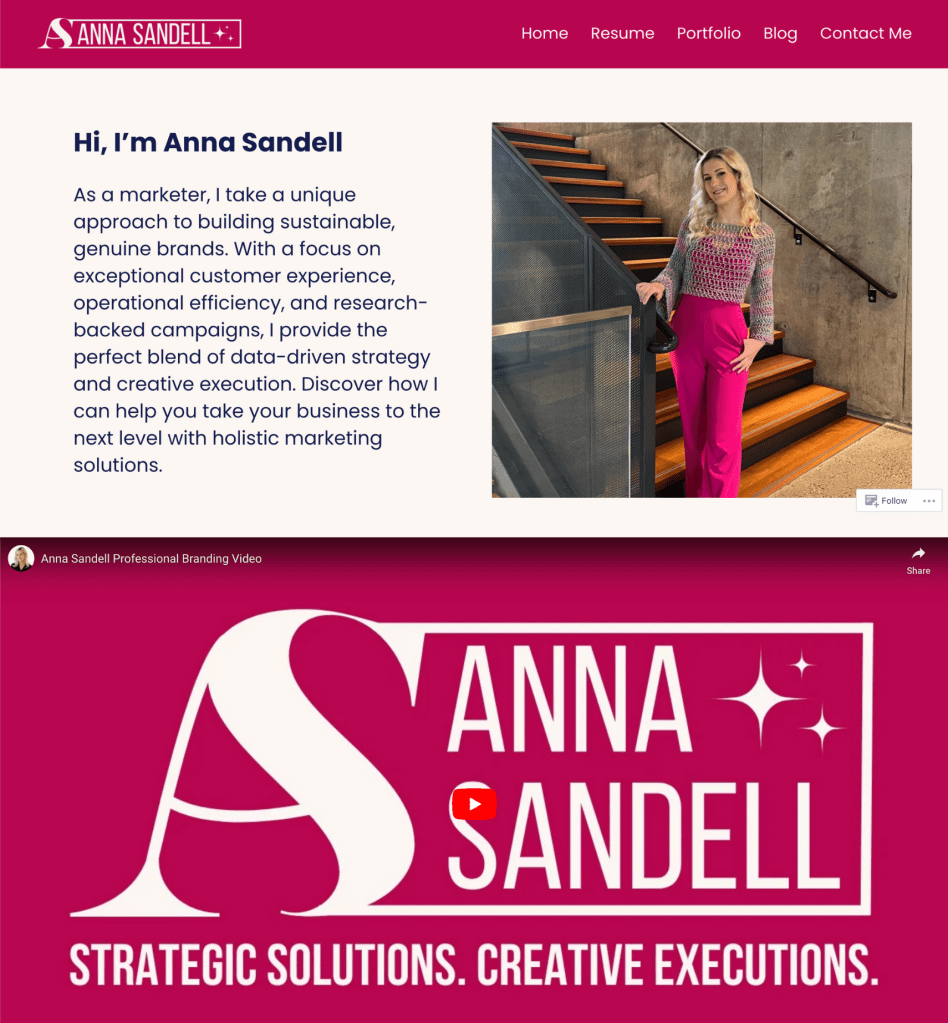
Those wireframes eventually turned into this home page:
Staying on-brand across all of your marketing collateral can be tough when you’re working solo but, when you have a team, it can feel nearly impossible to create consistent collateral day in and day out.
It’s no secret that I love Canva, maybe an unhealthy amount. I sing the praises of this website to anyone who will listen, but why? There is no shortage of answers I could give to that question but today I’m talking about two features that are absolute godsends when it comes to streamlining content creation and staying consistent while working as a team.
Brand kit
Without a doubt the most important Canva feature for creating consistent, integrated marketing collateral. Canva allows you to add logos, colors, and fonts to your brand kit. The elements you add to the brand kit are then easily accessible any time you go to pick a color or add some text to a Canva design.
Colors: Canva allows you to add your brand colors by hex code but, if you don’t know the hex code, the color picker tool can help you figure it out in seconds.
Fonts: Canva has a variety of fonts for you to choose from but, if your favorite isn’t available, you can download it here.
Logos: Canva accepts a variety of file types for logos but I recommend adding a SVG file, this will allow you to easily change the color of your logo to suit your design.
Brand Templates
Brand templates would be a strong contender for first place if Brand Kits weren’t SO convenient. Brand templates differ from Canva templates in that Brand templates are created by a member of your team and only made available to other team members, unlike regular templates that are open to anyone. Templates are most useful if you’re working with a team as they allow to share designs throughout your organization so the collateral stays consistent, no matter who makes it. If you’re working solo, templates are still a super convenient way to store designs you use time and time again.
During my internship at Guide Property Services, I introduced Canva to the organization and created a number of templates for my colleagues. The YouTube End Screen Template and YouTube thumbnail templates have gotten the most use.
Canva is one of the most utilized tools in my tool belt, and if you haven’t tried it yet, you need to. I think you’ll be surprised by how much you can create and how easy it is to stay on-brand.
Every brand needs a logo but how to go about getting one can be daunting. If you’ve got some cash to burn, you can hire a graphic designer in a matter of minutes on Fiverr. There’s also no shortage of free (or freemium) logo generators online. But, if you’re anything like me, you crave full creative control and can’t turn down the opportunity to learn something new. I learned quite a few new things this quarter in the process of developing logos for my personal brand and for a couple of apartment buildings, keep reading to learn my process.
Step 1: Finding Inspiration
Finding inspiration that sparks your creativity is essential to moving forward in the logo design process. If you’re lucky enough to already have some existing branding, that’s the first place to look for inspiration. If you don’t have any existing branding, you may be able to find inspiration in the design of the product itself.
For example, when I developed this logo for a new apartment building in Delridge, the only thing I had to go off of was a handful of architectural renderings. As you can see, I used the building silhouette as the basis of the logo. (I also pulled colors from a screenshot of the building on Google Maps).
Pinterest can be another great source of inspiration (just be sure not to steal someone’s design). Consider also the industry in which you operate and what styles, colors, fonts, etc. are popular.
Step 2: Choosing a Type of Logo
Before you can jump straight into creating your logo, there are a few decisions you’ll need to make.
First, what type of logo are you creating- is it just text? Just a graphic/icon? Or a combination of the two?
If you’re making a text-only or combination logo:
Are you using the full brand name or just the initials (monogram)?
Do you want to include your tagline?
Will you be using a serif or sans-serif font?
Are you using more than one font?
If you’re making a graphic/icon-only or combination logo:
Will the art style of the graphic be detailed or simplified?
Is the graphic/icon intended to explicitly represent a tangible thing or is it more abstract?
The next step of my logo design process takes place in Canva (I would be nothing without Canva). Heads-up that you will need a premium membership to download your designs as a vector file (.svg), it’s around $15/month for up to 5 people which I personally believe to be an insanely low number.
Lately, I’ve become a huge fan of Canva’s whiteboard feature, the limitless canvas allows me to collect and view all of my innumerable references and design iterations in one place. Here’s a sneak peek at the whiteboard I used for my (admittedly very overwhelming) brand color selection process.
When I’m drafting a logo in Canva, I often use blocks the same color as the background to artificially edit graphics/fonts in ways Canva won’t allow. Here you can see side-by-side the artificially edited monogram and all of the components that went into making it.
I could wax poetic about how incredible Canva is, and it is incredible, which is why I start drafting my designs there but when I eventually hit the limits of Canva’s vector capabilities (or begin having copyright concerns), I move into Vectornator.
Step 4: Refining in Vectornator
Vectornator is a free vector design software, that’s considered to be one of the better (free) alternatives to Adobe Illustrator.
There are a plethora of resources online that teach vector design better than I could ever hope to do in a blog (even if I was actually well-versed in the subject). My process for this step is as simple as downloading a Canva Draft as an SVG file, opening that file in Vectornator, and then doing my best to figure out how to do what I want to do (sometimes it’s a struggle to even figure out how to google my questions). This is where the non-designer part starts to be a real disadvantage but, it’s not a race and every hour I’ve spent fruitlessly toiling away in Vectornator has made me more adept at utilizing the software.
Extra tip: Once you’ve successfully created your logo, you can export it as an SVG file, and upload it to Canva as a graphic that is recolored to suit whatever your next design requires (extra points if you add it to a Canva Brand Kit).
Now you’ve got your very own, handmade logo and valuable graphic design practice. Once you start applying your logo across your marketing communications, you may find that it isn’t suitable for all applications (that’s how I ended up with three logo variations). That’s more than ok! Back to the drawing to add some new logo variations to your brand kit.
Addressing the drug epidemic isn’t the only thing Reagan got wrong but, it was definitely one of them. America’s longest war celebrated its 50th birthday last year but, nowadays it’s relatively well-accepted that War on Drugs failed or, to put it another way, drugs won. (This article is *eventually* about digital marketing, just hang with me for a minute.)
Incarceration isn’t the answer
A report published by The Global Commission on Drug Policy all the way back in 2011 concluded that “Arresting and incarcerating tens of millions of these people in recent decades has filled prisons and destroyed lives and families without reducing the availability of illicit drugs or the power of criminal organizations”.
Correlation may not equal causation but it does appear that criminalizing drug use hasn’t been all too effective at preventing overdose deaths.
Why we lost the War on Drugs
To understand why the War on Drugs and programs like D.A.R.E. are ineffective, it can be helpful to think of them as similar to abstinence-only sex-ed. Abstinence-only approaches to sex and drug use are unsuccessful at improving health outcomes because these approaches fail both to acknowledge the reality that not everyone will abstain and to equip participants with the tools or knowledge necessary to mitigate risks.
Before we get into what can be done in the ongoing fight against the drug epidemic we need to consider what the ultimate goal is. If the goal of the War on Drugs was simply to punish people suffering from drug addiction, it was successful. However, if the goal is reducing fatalities and negative health outcomes resulting from drug use, a course correction is in order.
So, if criminalization isn’t the answer, what is?
America lost the war on drugs by using a carceral approach which proved to be both ineffective and demonstrably harmful. If we want a fighting chance against the drug epidemic, a harm-reduction-focused social marketing approach is our best bet.
Social Marketing and Harm Reduction
“Social marketing” refers to using traditional marketing techniques to promote behavioral changes that benefit individual/societal health rather than products or services. Similarly, the term “harm reduction” is used to refer to strategies, programs, and public health initiatives aimed at minimizing the negative consequences of drug use.
4 Key Principles
According to The Society for the Study of Addiction (SSA), social marketing is characterized by four key principles, voluntary change through the principle of “exchange” (that there is a clear benefit for the individual to change), the use of marketing techniques, segmentation and targeting, and a “marketing mix” of different methods, aimed at the benefit of the individual and society, not an organization.
End Overdose is one example of a nonprofit that’s figured out how to use digital marketing strategies (namely TikTok) to promote harm reduction practices with the goal of reducing opioid overdoses.
Let’s take a look at End Overdose through the lens of social marketing principles to discuss what they’re doing right and what opportunities they have to improve.
Voluntary Change Through the Principle of Exchange
This principle is absolutely integral to both social marketing and harm reduction. It’s also something that End Overdose does very well.
End Overdose promotes harm reduction practices which are predicated on the philosophy of meeting people where they are and giving them practical ways to reduce the risks associated with their current drug use.
In exchange for making the changes it promotes, End Overdose offers the biggest possible benefit, not dying. The organization’s slogan: “NO ONE ELSE HAS TO DIE”, drives this point home.
Marketing Techniques
End Overdose has garnered media attention for its masterful use of TikTok to educate young people about harm reduction.
In an interview, founder Theo Krzywicki explained the organization’s TikTok strategy “We just do trends, really…TikTok’s algorithm favors whatever is trending … So we answer basic questions, we’ll do how-to videos. A big thing is they’re really simple. We don’t use them to be like training pieces, we use the videos to just garner attention and drive traffic to our online resource, or how people (take a course) with us in person”.
End Overdose also sells a variety of branded clothing and stickers which allow for word-of-mouth marketing. Unlike some branded merch, End Overdose’s products are quite aesthetically pleasing and on-trend, increasing the probability that people will use the products and that other people will ask where they got them.
Segmentation and Targeting
End Overdose’s use of TikTok makes perfect sense for its target market. Overdose deaths are highest among people aged 15-34 years old and over 65% of TikTok users are in the same age range.
Aside from demographics, it’s important to note that while programs like D.A.R.E. are more focused on young people and children that have not yet used drugs, End Overdose is targeted more toward active drug users and the people around them, though I think most people should carry Naloxone and know how to administer it.
Additionally, it seems that End Overdose has more of a focus on casual/social users of illicit drugs (like college students and rave goers) while many other harm reduction organizations target maintenance users, IV drug users, and people experiencing homelessness.
Marketing Mix
Product: With social marketing, the product is the behavioral change being encouraged. End Overdose promotes a variety of harm reduction practices like using fentanyl test strips, carrying Naloxone, learning the signs of an overdose (End Overdose offers free in-person and online training), and destigmatizing drug use.
Currently, End Overdose provides free Narcan (Naloxone) with mandatory online training and fentanyl test strips are available in a free 2-pack, as well as packs of 5, 50, or 100 for around $1 per strip or as a monthly subscription for $4.99/month.
Price: The element of price in social marketing refers to the cost of the behavior change. For example, while there are many places to get free fentanyl test strips, the money lost to disposing of laced drugs can be very real for many addicts and shouldn’t be ignored. Additionally, publically advocating for harm reduction can have social and professional consequences due to ongoing stigma.
Place: For End Overdose, the main goal is driving traffic to its website where visitors can order Naloxone and test strips, this is a great option for people that have access to the internet and a mailing address but many people struggling with addiction don’t which is why it’s so important that other organizations focus on in-person outreach.
Opportunities
End Overdose has a number of opportunities to improve its social marketing efforts. The first thing I would focus on is improving the webpage design and UX. The current website leaves a bit to be desired which is a critical flaw for an organization that focuses heavily on driving website traffic.
Landing Page and Form Design
The landing page is relatively well-designed but clicking “Get Narcan” takes you to a page titled “My Account” with forms to log in or register but no additional information. It’s unclear what exactly you’re registering for and whether or not the Narcan is free. I would change the title, add some more information to this page, and switch to a multi-stage form design to increase conversions.
Website Navigation
The website navigation could be improved by adding the section titles to the drop-down menus. As you can see below, hovering over “Our Services” shows the options “Submit Reversals”, “Submit FTS Results”, and “FAQs”. Ignoring the fact that none of those options are services, it wasn’t immediately clear to me that clicking on the “Our Services” text would take me to a page that described the services.
To improve website navigation and add valuable information to the site, I’d recommend creating pillar pages defining each of End Overdose’s services, listing those pages in the “Our Services” drop-down, and moving the reversal and FTS submission forms to a new section. The new pillar pages would also be a great way for the site to improve its SEO ranking.
SEO
I found End Overdose through this article on Today.com. Despite making numerous searches with keywords related to harm reduction and services the organization offers, I didn’t find it on the SERP, organically or otherwise. See below a report I pulled from SpyFu which shows that End Overdose ranks on the first page for 23 keywords with a total combined monthly search volume of 184 and only 8 clicks from SEO.
Looking at the website’s “Press + Publications” page revealed a number of quality backlinks from reputable sites. It appears to me that End Overdose’s website is severely lacking in the words department. There just isn’t very much content on the site which is absolutely contributing to its low SEO traffic.
I’d recommend adding more content about harm reduction practices, services offered, and the positive impact of the organization as this could be hugely beneficial to End Overdose’s ranking and traffic from SEO.
In closing…
Making any real progress in reducing overdose fatalities is going to require the widespread adoption of harm-reduction practices. Like it or not, no one can be forced to recover from addiction until they’re ready and they can’t recover at all if an overdose kills them first.
The CDC reports that “In nearly 40% of overdose deaths, someone else was present. Having naloxone available allows bystanders to help a fatal overdose and save lives”. Drug overdoses are a leading cause of death among young people but, they don’t have to be. The tools and knowledge we need to drastically reduce that death toll already exist, they just need to be distributed.
Digital marketing gives us the opportunity to do just that.
I’m a marketer, not a programmer, why should I learn to code?
The answer to why it’s beneficial for digital marketers to have some coding knowledge lies in the job title itself, –digital- marketer. Without code, there is no digital. It goes without saying that coding is an infinitely vast and complex field but digital marketers can see substantial returns from developing even a little bit of coding capability.
In my experience, if you’re the type of person who always thinks “there’s got to be a better way to do this”, you might just learn some coding accidentally. This summer I picked up a little Javascript while trying to find a faster way to import leasing data into a Google Sheet. I ran into some problems when the macro got so big I couldn’t run it without freezing up my Mac.
As they say…
Today, I’ll be talking primarily about HTML (not least of all because it’s one of the easiest coding languages to learn). If you’re about 5-15 years older than me, there’s a good chance you picked up some HTML or CSS to customize your MySpace page. HTML or HyperText Markup Langauge defines the content elements of websites, understanding HTML becomes especially important for marketers working on SEO but, it’s still absolutely worth learning even if that’s not your specialty.
MySpace Code
Don’t know where to start?
When it comes to learning how to code, there’s a plethora of online courses available (unsurprising, the tech community has a huge digital presence). One of the more popular options is Codecademy.
Codecademy
Codecademy offers free coding courses in 11 languages so, it’s a great place to start no matter what you want to explore.
I started Codecademy’s introductory HTML course a while back, I highly recommend their courses, especially if you’re a very hands-on learner like me. The course gives you the chance to write a couple of lines of code after each element is introduced which makes for an engaging experience.
In my current job, I’ve found that some fundamental knowledge of HTML comes in quite handy for Craigslist posts. Craigslist’s interface doesn’t allow for automated ad posting in the way that sites like Zillow or Trulia do, which means that advertising apartments on Craigslist must be done by hand. Luckily AppFolio (the software we use to market apartments) provides the ad copy in an HTML format so the ads we post manually to Craigslist can take the same format as those posted automatically to other sites. This HTML makes a huge difference in the consistency and professionalism of our manually posted ads.
Here you can see the difference in Craigslist ads made with and without HTML, learning just a little bit of HTML has allowed me to confidently make edits to our ads without any collateral damage.
WordPress
WordPress is the most popular website builder/CMS, the platform can accommodate people with no experience creating websites as well as more tech-savvy individuals. In fact, over 40% of sites on the internet use WordPress.
WordPress is frequently lauded for its ease of use but in the interest of full disclosure, I have not found that to be the case. In my non-expert opinion, the Wix interface (while less technically flexible and powerful) is much more intuitive and quite serviceable for simple, personal sites like this.
However, Wix is limited in that it doesn’t automatically allow users to edit code. WordPress does have this option, when editing a page in WordPress, it’s easy to switch between “Visual Editing” which functions like a word processor, and Code Editing which allows you to write in HTML code.
WordPress also allows you to write using the visual editor and then switch to the code editor to see how your writing translates into code. While this isn’t a structured way to learn HTML like CodeAcademy, it is even more hands-on (and you end up with a real website).
Here I’ve pasted the same HTML as the Craigslist ad into the WordPress code editor and then switched to the visual editor to italicize the title. After switching back to the code editor, you can see that the emphasis tags (<em> </em>) have been added automatically.
Squarespace
Squarespace is a website building and hosting platform that allows users to quickly customize pre-built templates with easy drag-and-drop editing.
Squarespace is very similar to Wix in its design interface, I found it much easier to make aesthetic changes in Squarespace than in WordPress. Unlike Wix, Squarespace does come with HTML editing built-in. Something I really appreciate about the Squarespace code editor is that it’s visually very similar to the CodeAcademy interface, clicking on the opening or closing tag automatically highlights the other tag, making it easy to see what elements are between the tags.
Unfortunately, I wasn’t able to switch between the code and visual editor in Squarespace like in WordPress which I think makes learning HTML in Squarespace significantly less feasible.
Here you can see the Squarespace code editor. The code block can be easily dragged and dropped around the page which makes it easy to arrange your site to your own personal preferences.
Final Thoughts
Ultimately, each platform has its benefits and detriments, the right choice for you will depend greatly on your needs and use case. For a step-by-step learning experience, Codecademy is a great option but it’s fundamentally different from WordPress and Squarespace in that it’s not a website builder. Likewise, while you can explore HTML with WordPress and Squarespace, those sites aren’t designed to teach you how to code.
As a marketer, I’d recommend Codecademy for structured learning, WordPress for hands-on learning, and Squarespace for getting a simple website up and running as quickly and easily as possible.
Paid social has a place in every brand’s marketing strategy but, what exactly is it? And more importantly, how can it help you achieve your business goals?
Paid social media marketing is the practice of paying a social media platform (Facebook, Instagram, TikTok, Twitter, LinkedIn) to promote a specific piece of your content/collateral to a targeted audience.
Most commonly these ads are billed based on clicks (CPC) but, depending on your marketing objectives, you can also elect to pay by impressions (CPM), or video views (CPV). The average cost per click can range from $0.38 (Twitter) all the way up to $5.26 (LinkedIn), which makes paid social a relatively inexpensive marketing strategy.
Paid and organic social media marketing both utilize the same platforms, but their use cases are different. Organic social media marketing is great for building and nurturing relationships with current customers, while paid social is better suited for generating brand awareness and gaining new customers. The top of the funnel is where paid social shines the brightest but, make no mistake, paid social has an important role throughout the entire funnel.
The primary advantage paid social has over organic is the ability to target specific audiences. Creating marketing collateral for every stage of the buyer’s journey is important for most marketing strategies but, paid social has the added benefit of ensuring that the content you create is shown to buyers during the correct stage of their journey.
Meta (Facebook and Instagram) is the biggest player in the paid social game which makes understanding their ad targeting options essential for any digital marketer. Those options are “Core”, “Custom”, and “Lookalike” audiences. I’ll define each option in depth as I explain their roles in the marketing funnel.
Awareness
Stage Goals: In the awareness stage, customers are aware that they have a need but, they don’t know how they’re going to address it. In this stage, the goal is to reach potential customers that haven’t heard of you and get them acquainted with your brand/products.
Targeting: Core and Lookalike audiences are used for the awareness phase. Core audiences allow you to target your ads to potential customers fall under a specified set of demographics. Use your Buyer Personas to determine which demographics should be targeted.
Additionally, the demographics that you wish to target should be used to inform the social media platforms where you place ads. For example, if you’re selling life-alert bracelets, Facebook will probably be a better choice than TikTok.
Lookalike audiences are also a powerful tool for the awareness stage, ads that use lookalike audiences are targeted at users that “look-alike” current customers. Lookalike audience targeting works by showing your ads to users that are similar to the selected “source audience” (such as fans of your Facebook page).
Consideration
Stage Goals: In the consideration stage, your potential customers are aware of your brand and/or actively seeking solutions to their problems. The goal in this stage is to explain the benefits of your products and how they can solve your customer’s problems.
Targeting: Core and lookalike audiences are an excellent option for this stage as well. You can also use the viewers who engaged with your awareness phase content as the source audience for Lookalike targeting. Another great strategy in the consideration stage is using Custom audiences to retarget users engaged with your awareness phase content.
Decision/Conversion
Stage Goals: In the decision phase, buyers are aware of their problem and have evaluated the potential solutions. They’ve decided on a solution category and are choosing between the different brands/products within that category. The goal in this stage is to give them the final push towards conversion (often a purchase).
Content: Content for the decision/conversion stage is the most promotional, it’s the kind of content that most people think of when they hear “advertising”. Your content for this phase should motivate buyers to convert with calls to action, discount offers, and the like.
Targeting: The decision/conversion phase is the perfect time to retarget users that engaged with your consideration phase content. You can retarget by creating custom audiences from engagement with previous ads, website traffic, and other conversions. It may also be beneficial to target lookalike audiences that highly resemble your most valuable customers.
The Other Type of Paid Social: Influencer Marketing
As customers have become more adept at ignoring advertisements, influencer marketing has skyrocketed in popularity, and for good reason. At the end of 2018, 89% of marketers surveyed reported that the ROI on influencer marketing was comparable, if not better than other methods.
The strategy of influencer marketing involves paying prominent social media figures (in cash or product) to endorse your brand and products.
Influencer marketing gives brands the unique opportunity to purchase positive word-of-mouth. Even though influencers are legally required to disclose when they are being paid to promote a product, the trust they’ve built with their followers can make the endorsement feel authentic and credible.
KPIs (Keep Paying Influencers)
The effectiveness of an influencer marketing campaign can be more difficult to measure than other digital marketing campaigns but, it’s still completely possible. Monitoring the use of brand-specific hashtags or keywords is one method. Success can also be measured through the engagement a sponsored post receives. Last, but certainly not least, influencer-specific tracking links and promo codes can be an excellent way to measure (some) of the conversions generated by an influencer.
Now more than ever, consumers don’t want to feel like they’re being “sold to”. They’re tired of being interrupted by impersonal, aggressive promotion ads. It’s no secret that traditional marketing tactics are becoming less effective. Fortunately, adopting a content marketing strategy can enable your business to attract customers, increase engagement, and win conversions.
As defined by the Content Marketing Institute: “Content marketing is a marketing technique of creating and distributing valuable, relevant and consistent content to attract and acquire a clearly defined audience – with the objective of driving profitable customer action.”
It’s time to take your marketing to the next level. Keep reading for 4 important rules of content marketing, illustrated with expert examples.
1. Create content that provides value to your audience.
The crux of content marketing is that it must be valuable to your audience. Valuable is a pretty vague term but that’s by design. “Valuable” means something different for every customer, brand, industry, and even content platform. This is why the most important step in developing a content marketing strategy is getting to know your customers. After all, you can’t know what they’ll find valuable if you don’t even know who “they” are.
In my last blog, I wrote about the process of developing buyer personas, these semi-fictional profiles of your ideal customers will come in very handy for your content marketing. Your buyer personas will help you determine everything from what topics your content should cover to what formats/platforms you should use to disseminate that content.
Not only should you create content targeted at each of your buyer personas, but you should also tailor-make content for each phase of the buyers’ journey. A great content marketing strategy holds the customer’s hand all the way through recognizing a problem, considering their options, making a purchase decision, and then using that purchase to solve their problem.
For an example of content marketing that delivers amazing value to its audience, look no further than Nike Training Club.
Nike has used what it knows about its customers to create something valuable to them; an app that provides hundreds of free at-home workouts, educational articles, recipes, and more. Staying true to the slogan, Nike offers free guidance on how to “Just Do It”.
Now, if you were to begin your fitness journey with the Nike Training Club app and eventually decided that you’d benefit from a new pair of sneakers, which brand would be at the top of your list? Probably Nike.
This content marketing is especially successful because it provides value to buyers at every stage of their journey. The app is a great resource for both fitness beginners that haven’t purchased a single piece of equipment and avid Nike collectors looking for more ways to use their gear.
2. Be consistent (don’t join the blog graveyard).
If you’re looking for a one-and-done scheme, content marketing might not be the best strategy for your business. Creating and sharing content on a regular basis is essential to building your credibility, increasing brand awareness, and establishing an ongoing relationship with your customers.
You’ve probably heard that it takes seven exposures to an advertiser’s message for a prospect to take action. Consistently sharing content will allow you to get those precious exposures. Regular posting will also allow you to generate more content, broadening the range of topics covered, and thus expanding the variety of customers you’re able to attract.
Consistency is key to becoming a trusted advisor and reliable course of information for your audience. It can be daunting to step on the content creation hamster wheel but, making a content calendar can help.
When it comes to consistent, sustained content marketing, AARP is a gold-star student.
The lobbying group concentrates on issues affecting adults over the age of 50, it also boasts a membership of almost 40 million and the nation’s top two most circulated publications.
AARP made its foray into publishing almost 70 years ago in 1958, and has been publishing AARP Magazine (in its current form) six times a year since 2002. Cementing itself as an evergreen source of lifestyle content for the 50+ demographic. Print may be dead in the eyes of many digital marketers but AARP demonstrates the value of consistency and knowing your customer’s media habits.
3. Showcase your unique voice and personality.
Your content shouldn’t be a sales pitch, so it’s important to evoke your brand by creating content that relays the values and personality of your brand. While traditional marketing talks at customers, content marketing talks to them. When your content is written in your brand’s voice and targeted to customer wants and needs, it’s much easier for them to emotionally connect with your brand. That connection creates brand preference and loyalty.
One brand that’s mastered this skill is Duolingo.
Duolingo manages to pull off a sassy, unhinged, corporate Tik Tok presence where so many other brands have tried and failed spectacularly. Duolingo is successful with this strategy because it makes sense for the product and feels authentic to the brand. The Duolingo app is positioned as a fun, engaging way to learn a language in the digital age so, it only makes sense that its content is fun, engaging, and demonstrates its tech savvy-ness.
Now, if you’ve downloaded Duolingo, you’re probably familiar with the incessant, vaguely threatening reminders to complete your daily lesson. When Duolingo saw the flurry of memes concerning these reminders, the brand embraced it and made the giant green owl character a little bit unhinged on social media. That decision has served the company very well but, it’d be a disastrous decision for most other companies. Focus on finding your brand’s voice and creating content that feels authentic.
4. Don’t be pushy.
Your content marketing should provide value to customers in a manner that both supports your business objectives and avoids a hard sales pitch. Any value you provide can be quickly undercut by overt promotion, the sales pitch hidden in your helpful article looks like a conflict of interest and is more likely to drive readers away than win a sale. However, this doesn’t mean that content marketing can’t steer customers to your products, quite the opposite, it just requires a bit more creativity and finesse.
Take, for example, Michelin. Yes, like the tires AND the stars.
Over 120 years ago, the French tire manufacturer Michelin first published the “Michelin Guide”. When the guide was published, driving a car was still viewed as a novelty. The guide was a catalog of French restaurants, hotels, and gas stations, created to encourage customers to view the car as a practical form of transportation for driving between those restaurants and hotels. A few years later, Michelin began reviewing fine dining restaurants and adopted the now famous 3-star rating scale.
Although many Americans aren’t aware that Michelin Stars are handed out by a tire manufacturer, the connection is well-known in its native France. Either way, no one can deny that demand for tires has skyrocketed since the introduction of the Michelin Guide in the year 1900.






















 Home | Anna Sandell